
Each year, thousands of Victorian Year 8 students sit a single exam that decides entry into the state's four selective entry high schools: Melbourne High School, The Mac.Robertson Girls' High School, Nossal High School, and Suzanne Cory High School. Roughly 1,000 places are on offer, and every applicant, regardless of which schools they preference, sits the exact same exam, administered by the Australian Council for Educational Research (ACER).
Yet most families begin preparation without a clear picture of what is actually tested. Prep advice online is often outdated (many sites still describe the old five-test format), vague ("practise reasoning"), or borrowed from the NSW selective test, which is a different exam entirely.
This guide fixes that. Below is the current exam structure, followed by a topic-by-topic breakdown of every section: the specific skills and content areas your child needs to have covered before exam day.
The Exam at a Glance (Current Format)
ACER restructured the exam beginning with the 2026 sitting (Year 9, 2027 intake). The old format of five separate 30-minute tests is gone. The exam is now delivered in three parts:
| Part | Test | Time | Format |
|---|---|---|---|
| Part A | Mathematics and Quantitative Reasoning | 60 minutes | Multiple choice (combined paper) |
| Break | 20 minutes | ||
| Part B | Reading and Verbal Reasoning | 55 minutes | Multiple choice (combined paper, ~75 questions) |
| Short break | 5 minutes | ||
| Part C | Writing | 40 minutes | Two written tasks |
Total exam time is 2 hours 35 minutes; the full session runs approximately four hours including registration and breaks. No calculators are permitted.
An important subtlety in how results are reported: although Part A is sat as one paper, Mathematics and Quantitative Reasoning are still scored and reported as two separate bands on the candidate report. Reading and Verbal Reasoning, by contrast, are reported as a single combined band. So your child receives four band results (Mathematics, Quantitative Reasoning, Reading & Verbal Reasoning, and Writing), each expressed as a percentile band relative to the exam cohort: Top 10%, Top 20%, Above Average, Average, or Below Average.
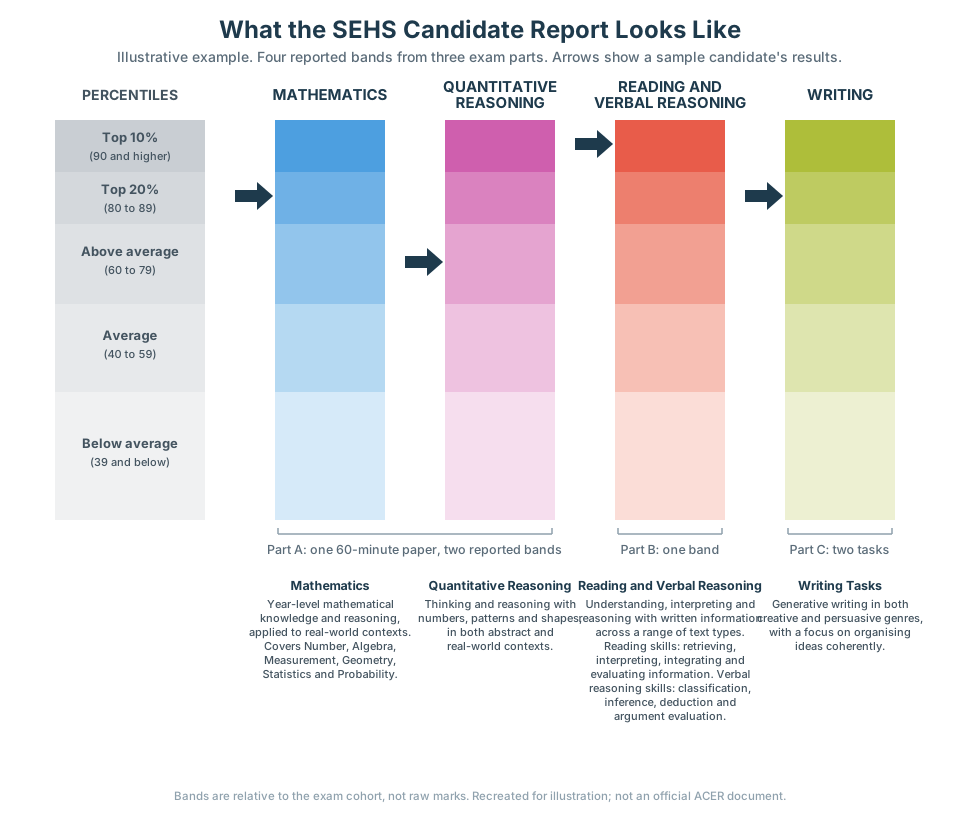
Selection is based overwhelmingly on exam performance (85%), with equity consideration (10%) and principal's discretion (5%) making up the remainder. Because results are ranked against a high-ability cohort, students realistically need bands in the Top 10 to 20% range across sections to be competitive.
Now, section by section.
Section 1: Mathematics
What it tests: Year-level-appropriate mathematical knowledge and the ability to apply it in unfamiliar, multi-step, worded contexts. This is the most curriculum-anchored part of the exam, but the questions are rarely presented the way they appear in a Year 8 textbook. Expect familiar concepts wrapped in unfamiliar problems.
Topics to prepare
Number
- Integer operations, including negatives and order of operations
- Fractions: all four operations, mixed numbers, fraction of a quantity
- Decimals: operations, rounding, converting between fractions, decimals and percentages
- Percentages: percentage of a quantity, percentage increase and decrease, reverse percentages ("the sale price is $84 after a 30% discount, so what was the original price?")
- Ratio and rates: simplifying, dividing quantities in a ratio, unit rates, best-buy comparisons
- Factors, multiples, primes, HCF and LCM
- Index notation and basic index laws; squares, cubes and roots
- Estimation and number sense under time pressure
Algebra
- Simplifying algebraic expressions; expanding brackets
- Substitution into formulas
- Solving linear equations, including with the unknown on both sides
- Forming an equation from a worded problem (the real skill being tested)
- Number patterns and sequences: finding the rule, predicting the nth term
- Working backwards / inverse operations problems
Measurement and Geometry
- Perimeter and area: rectangles, triangles, parallelograms, trapeziums, composite shapes
- Circles: circumference and area
- Volume of prisms; surface area basics
- Unit conversions (length, area, mass, capacity, time)
- Angle properties: angles on a line, at a point, vertically opposite, in triangles and quadrilaterals, on parallel lines
- Pythagoras' theorem
- Transformations: reflection, rotation, translation, and simple symmetry
- Time, timetables, and speed-distance-time problems
Statistics and Probability
- Mean, median, mode and range, including "find the missing value given the mean" style problems
- Reading and interpreting graphs: column, line, pie, dot plots, stem-and-leaf
- Simple probability as a fraction; complementary events; two-step sample spaces (dice, spinners, cards)
Financial Mathematics
- Discounts, mark-ups, GST-style calculations
- Simple interest
- Multi-step money problems (change, budgeting, comparing deals)
How the questions feel
Almost every question is worded. Many require two or three steps chained together, and the distractors are built from the most common wrong turns: forgetting to convert units, applying a percentage to the wrong base, or reversing a ratio. Accuracy under time pressure matters as much as knowledge. A student who knows all of the content above but works slowly will still leave marks on the table.
Section 2: Quantitative Reasoning
What it tests: The ability to think and reason with numbers, patterns and shapes in abstract and unfamiliar contexts. Unlike Mathematics, this section deliberately steps outside the curriculum. A drilled student with strong textbook maths can still score poorly here if they haven't practised novel reasoning, which is precisely why ACER keeps it as a separate reported band.
Topics to prepare
Number patterns and sequences
- Arithmetic and geometric sequences, alternating patterns, two-rule sequences
- Number pyramids, grids and magic-square-style puzzles
- "Number machine" problems: input, hidden operation, output; find the rule or the missing value
Abstract and figural reasoning
- Matrix puzzles (3x3 grids: work out the missing figure)
- Figure series: what comes next in the sequence
- Rotations, reflections and combined transformations of shapes
- Odd-one-out with figures
- Pattern rules combining shape, shading, size and position simultaneously
Spatial reasoning
- Nets of cubes and other solids: which net folds into the shape shown
- Cube counting in 3D stacks, including hidden blocks
- Paper folding and hole punching
- Views of 3D objects from different directions
Logical reasoning with numbers
- Balance and weighing puzzles (if two triangles equal three circles...)
- Deduction from numeric clues ("A is twice B; B is three more than C...")
- Age problems and before/after reasoning
- Substitution ciphers where symbols stand for digits
Data and proportional reasoning
- Interpreting unfamiliar tables, charts and diagrams quickly
- Proportional reasoning applied to novel scenarios: scaling recipes, map ratios, mixture problems
- Rate comparisons drawn from real-world data presented in the question
How the questions feel
Nothing here requires content beyond upper-primary arithmetic. The difficulty is entirely in the reasoning. The best preparation is exposure to a wide variety of puzzle types so that no format is being seen for the first time on exam day, combined with a habit of testing each answer option against the pattern rather than guessing from a glance.
Section 3: Reading (Part B, first strand)
What it tests: The ability to understand, interpret and reason with written information across a wide range of text types. Since the format change, Reading no longer stands alone. It shares a 55-minute, ~75-question paper with Verbal Reasoning, and the two are reported as one combined band. That makes pacing across the whole of Part B a skill in its own right (you have roughly 44 seconds per question).
Text types to be comfortable with
- Narrative fiction extracts: contemporary and classic, including openings dropped mid-scene with no context
- Literary description: mood- and imagery-heavy passages where the questions target atmosphere and implication
- Poetry, including free verse; students consistently find this the hardest text type
- Persuasive texts: opinion pieces, letters, speeches
- Expository and informational texts: science, history, geography, technology
- Biography and memoir
- Paired or comparative texts: two passages on a related topic, with questions asking how they differ in purpose, tone or perspective
- Texts with visual elements: passages accompanied by diagrams, tables or images that the questions draw on
Skills to prepare
- Literal comprehension: locating directly stated facts quickly (the easiest marks; they must be near-automatic)
- Inference: reading between the lines to work out what a character feels or what a writer implies but never states
- Main idea and summary: identifying what a passage or paragraph is fundamentally about, versus a detail that merely appears in it
- Vocabulary in context: working out what a word or phrase means as used in this passage, including words with multiple meanings
- Author purpose and audience: why the text was written and for whom
- Tone and mood: distinguishing wry from sarcastic, wistful from mournful; this is where high-ability students separate
- Figurative language: metaphor, simile, personification, and why the author chose the device
- Text structure and cohesion: how paragraphs connect, what a pronoun refers to, why the author ordered ideas this way
- Evaluating arguments: identifying claims, evidence, assumptions and weaknesses in persuasive texts
- Comparing texts: synthesising across paired passages
How the questions feel
Every answer option is plausible; wrong options are usually partly true. They tend to be accurate statements that don't answer the question asked, or inferences that overreach the evidence in the text. Students should be trained to justify their choice with a line from the passage, and to be suspicious of options containing absolute words ("always," "never," "completely") unless the text genuinely supports them.
Section 4: Verbal Reasoning (Part B, second strand)
What it tests: The ability to analyse language, understand relationships between concepts, and apply logic using words and ideas. These questions sit alongside Reading in Part B, so a student's combined band reflects both strands together.
Topics to prepare
Word knowledge and relationships
- Synonyms and antonyms, including shades of meaning between near-synonyms
- Word analogies: A is to B as C is to ___ (relationship types: part-whole, cause-effect, degree of intensity, function, category)
- Odd one out among words
- Words with double meanings; the word that fits two different sentences
- Vocabulary breadth generally. This is the single highest-leverage long-term investment, and it can't be crammed
Sentence-level reasoning
- Cloze / sentence completion: choosing the word that best fits meaning and grammar
- Rearranging jumbled sentences or identifying the sentence that doesn't belong in a paragraph
- Identifying the statement that must be true given a sentence
Logical deduction
- Syllogisms: "All A are B; some B are C; which conclusion follows?"
- Ordering and ranking puzzles: five children finish a race, given clues about who beat whom
- Arrangement puzzles: seating, scheduling, matching people to attributes
- Truth-teller and liar puzzles
- Identifying necessary assumptions and valid conclusions in short arguments
- Distinguishing what must be true from what could be true, which is the core discipline of the whole strand
Codes and symbolic reasoning
- Letter sequences and alphabet position puzzles
- Simple word codes: if CAT is written as DBU, how is DOG written?
- Symbol-substitution logic
How the questions feel
Verbal reasoning rewards precision. The most common errors are importing outside knowledge into a deduction question (only the given statements count), and choosing a conclusion that is probably true rather than necessarily true. Timed mixed practice matters here more than anywhere else, because these items sit interleaved with reading passages and students must switch modes quickly without losing pace.
Section 5: Writing
What it tests: Generative writing skill in both creative and persuasive genres. Part C requires two written tasks in 40 minutes, typically one imaginative/narrative piece and one persuasive piece, each around 200 to 400 words. That's roughly 20 minutes per piece including planning, which makes this as much a test of composure and process as of raw writing talent.
Task 1: Creative / Narrative writing
Prompt types to practise
- An image as a stimulus
- A given opening or closing line
- A single theme word ("Lost," "The Door," "Change")
- A scenario or "continue the story" prompt
Skills to prepare
- A tight structure that fits the word count: orientation, complication, resolution, with the discipline to keep the story small (one scene, one or two characters) rather than attempting an epic in 300 words
- "Show, don't tell": conveying emotion through action, dialogue and sensory detail rather than labelling it
- A distinctive narrative voice and consistent tense and point of view
- Varied sentence openings and lengths for rhythm and tension
- Precise, ambitious vocabulary used correctly. One perfectly chosen word beats three impressive-sounding wrong ones
- Figurative language deployed sparingly and purposefully
- Strong openings that land the reader mid-moment, and endings that resolve or resonate rather than stop
- Planning in 3 to 4 minutes: characters, setting, the single turning point, the final line
Task 2: Persuasive writing
Prompt types to practise
- A statement to agree or disagree with ("Homework should be abolished")
- A question inviting a position
- A scenario requiring a recommendation (a letter to the principal, a speech to the school)
Skills to prepare
- A clear contention stated early and sustained throughout
- Paragraph craft: point, explanation, evidence or example, link back to the contention
- Two or three well-developed arguments rather than five thin ones
- Anticipating and rebutting the strongest counterargument, a hallmark of top-band responses
- Persuasive devices used with control: rhetorical questions, rule of three, emotive language, statistics or expert framing, direct address
- Formal, consistent tone matched to the audience specified in the prompt
- A conclusion that reinforces the contention with a call to action or final appeal, not a mere restatement
What markers reward
Across both tasks, responses are judged on the quality and development of ideas, structure and organisation, vocabulary and sentence control, spelling, punctuation and grammar, and, for the creative task, originality. Legible handwriting under time pressure matters more than families expect: practise both pieces by hand, timed, regularly.
What About Year 10 Entry? A Different Exam, A Different Process
If your child misses the Year 9 round, a second (much smaller) door exists, but it is important to understand that it is a genuinely different pathway, not a resit of the same exam.
It is run by the schools, not centrally. The ACER-administered process described above covers Year 9 entry only. Entry to Years 10 to 12 is handled directly by each selective school. Families apply to each school individually, and each school sets its own conditions, dates and fees.
It is a different exam from a different provider. Later-year entry uses the Edutest Academic Ability Assessment, not the ACER exam. All four schools share the one Edutest sitting: a student applying to multiple selective schools sits the exam once, and the results are transferred to every school they applied to. The Edutest format is structured differently from the current ACER paper. Rather than combined papers, it runs as separate sections covering verbal reasoning, numerical reasoning, reading comprehension, mathematics and written expression, in the traditional short-section Edutest style. A student who prepared for the ACER format will find the underlying skills familiar but the question styles, pacing and section structure noticeably different.
The exam matters less than it does at Year 9. This is the biggest difference, and the one families most often miss. For Year 9 entry, exam rank drives 85% of offers. For Year 10 entry, Melbourne High states explicitly that the assessment is not the main determinant. Selection is holistic: the application form, school reports, demonstrated co-curricular and sporting involvement, and an interview with a school selection panel all carry real weight, and offers are made strictly from the panel's ranking of shortlisted, interviewed candidates. The 4% school cap and the principal's discretionary category from the Year 9 process also do not apply.
Places are scarce. Where the Year 9 round offers roughly 1,000 places state-wide, Year 10 intakes are small. Melbourne High enrols a minimum of around 28 additional students at Year 10, and other schools' later-year intakes are similarly limited and depend on vacancies. Competition per place is therefore intense, and a strong exam result alone will not secure an offer without the co-curricular record and interview to match.
Timing runs on the same winter cycle. As a guide, in the 2026 round the Edutest registration for Year 10 entry closed in late May, with the assessment sat at the schools in mid-June, shortly before the main Year 9 ACER exam date. Each school publishes its own dates, so check the individual school websites for the year you are applying.
What this means for preparation. A Year 10 applicant should prepare in Edutest style, not ACER style: shorter discrete sections, Edutest question conventions, and a written expression task, alongside deliberately building the co-curricular evidence and interview readiness that the selection panel weighs. Eligibility note: Mac.Robertson accepts applications for its later-year intake from students currently in Year 9 or Year 10, and equity fee consideration is available for the Edutest registration at participating schools.
Building a Preparation Plan
With the full topic map above, an effective preparation sequence looks like this:
1. Diagnose before you drill. Sit a full-length practice exam under timed conditions early. The goal isn't the score. It's finding out which specific topics and question types are costing marks. Preparation guided by a real error profile is several times more efficient than working front-to-back through a book.
2. Fix reasoning errors, not just answers. When a question is wrong, the important information is why. Was it a misread question, a genuine content gap, a pattern spotted incorrectly, or a plausible distractor that exploited a specific misconception? Keep an error log organised by topic and error type. Students who review their mistakes this way improve dramatically faster than students who simply do more questions.
3. Train the combined-paper format. Because Part A mixes mathematics with quantitative reasoning and Part B interleaves reading passages with verbal reasoning items, practice should eventually mirror that: long mixed sittings, not just single-topic worksheets. Pacing, especially the roughly 44 seconds per question across Part B, must be rehearsed, not discovered on exam day.
4. Grow vocabulary and reading range continuously. The reading and verbal strands can't be crammed. A student who reads widely for the year before the exam, across fiction, quality journalism, and non-fiction in science and history, walks in with an advantage no worksheet can replicate.
5. Write to time, every week. Two pieces in 40 minutes is a demanding format. Weekly timed writing, followed by targeted feedback against the criteria above, builds the fluency and calm the task requires.
6. Finish with full simulations. In the final two months, complete exams under exact exam-day conditions (timing, breaks, handwritten responses) so that the real day feels routine.
The Bottom Line
The SEHS exam is competitive, but it is not mysterious. Every section maps to a finite, learnable set of topics: the ones listed above. The students who succeed are rarely the ones who did the most questions. They're the ones whose preparation was diagnostic: they knew exactly which skills were weak, understood the specific reasoning errors behind their wrong answers, and closed those gaps systematically.
That philosophy, identifying not just that an answer was wrong but why, is the foundation AdaptAce is built on. Every practice question on the platform tags each wrong answer with the specific misconception it represents, so students and parents can see precisely which of the topics in this guide need work, and the practice adapts accordingly.
Good luck to every family preparing. Start early, prepare diagnostically, and trust the process.